
Why Trying to Fix Your Wife's Problems Always Backfires
May 26, 2026
There’s something almost universal about men in relationships: we tend to be natural fixers. When something is broken, we want to repair it.
That instinct, although it may not always feel this way, is one of your greatest strengths. It’s how you build things, lead people, solve problems at work, and create stability in your environment, and it’s a big part of why people rely on you.
Marriage is a little different, however. Instead of bringing you closer, it can actually create distance.
And most men don’t notice this until it’s been going on far too long.
Why Your Fixing Instinct Makes Perfect Sense
If you look at your life, it makes total sense why you operate this way.
At work, problems need solutions. At home, things need maintenance. In life, challenges need action. So over time, your brain gets trained to treat discomfort as something that should be eliminated as quickly as possible.
When your wife brings you something emotional, your internal system automatically starts scanning for solutions without even realizing it.
What should she do differently?
What would make this better?
How do we prevent this from happening again?
From your perspective, you’re doing exactly what a competent partner should do: you’re trying to help.
Here the missing piece: emotional moments don’t follow the same logic as practical problems.
Where Things Start to Go Wrong
The issue with these responses in emotional moments is that she’s not bringing you a problem to solve. She’s bringing you an experience to be understood.
When you respond with solutions too quickly, even if they’re good ones, she doesn’t always experience it as help. What she often feels instead is that her emotions are being redirected, corrected, or minimized. It can come across like the focus is no longer on what she’s feeling, but on what she should do about it.
So while you may think you’re stepping in to improve the situation, it can feel like you’re stepping over the experience itself.
The Hidden Reason You Go Into Fix Mode
To really understand this pattern, it helps to look at what’s happening underneath it.
Think about the last time someone you care about was emotional. For lots of men, one of the primary feelings they have felt is discomfort. Not because they don’t care, but because emotional intensity is hard to sit with when their default wiring is action-oriented.
Fixing becomes a way to regulate that discomfort. If you can solve the problem, you can reduce the emotional tension in the room. And if you can reduce the tension, you can feel more settled again.
There’s also another layer. A lot of men are taught, directly or indirectly, that being valuable means being useful. When a problem shows up, your identity naturally leans toward contribution through action.
But emotional connection requires presence first, then action (if at all). And that’s the part most men were never taught.
What She’s Actually Looking For
In most of these moments, your wife isn’t asking you to take over the situation, and she’s not secretly hoping you’ll engineer a solution she couldn’t think of herself.
What she’s really looking for is something much simpler. She just wants to feel like you’re in it with her.
Not fixing it, or steering the situation. Inside it with her.
When you can do that, the goal is no longer to remove the feeling. Instead, letting her know that you’re standing together with her.
When a woman feels emotionally alone in something, even a small issue can feel heavier. But when she feels accompanied, even a big issue becomes easier to carry.
Why Listening Feels Like You’re Doing Less

Listening (truly listening) is something many men struggle with. It feels passive, or like you’re not contributing. Deep in your heart, you have a solution that you are convinced will make a difference, so it can even feel like you’re holding back what you think might actually help.
So your instinct pushes you to “add value” through advice.
What actually helps in those moments is not jumping ahead to the solution, but staying with what she’s feeling long enough for her to feel understood. Research on emotional validation and active listening has consistently shown that feeling emotionally understood strengthens trust, safety, and relationship satisfaction over time.
That might look like simply hearing her out without interruption, reflecting back what you heard in your own words, or acknowledging the emotional weight of what she’s saying before anything else enters the conversation.
Most of the time, she knows what she needs to do. She’s strong, self aware, and smart enough to handle the solution. What she really wants is you to be with her inside it.
How the Pattern Creates Distance Over Time
It’s important to address this instinct, because when fixing becomes your automatic response to emotional moments, your wife may share less over time.
Not because she doesn’t trust you, and not because she doesn’t love you, but because the emotional experience of sharing doesn’t always feel fully received. Over time, she may start to feel like she needs to filter her emotions before bringing them to you, or that she has to brace for advice instead of connection.
From your side, nothing feels wrong. But emotionally, something important is missing: she doesn’t feel met where she actually is.
And that misalignment is how distance quietly builds.
What To Do Instead
The shift is not about doing less. It’s about doing something different.
When your wife brings you something emotional, the first move is to slow down enough to actually hear it and let her experience land before you respond.
Then, instead of guessing what she needs, you simply ask: “Is there anything I can do to support you?”
That one question removes the guesswork and immediately changes the dynamic, because you’re clarifying the situation, rather than jumping straight into fixing mode.
From there, most moments fall into one of three needs. Sometimes she wants help thinking it through. Sometimes she just wants to be heard. And sometimes what she really needs is comfort more than conversation.
A simple way to remember this is: Hand, Hear, Hug.
- Hand: She wants help thinking through the problem or support finding a solution.
- Hear: She doesn’t need advice, she just needs to be listened to and understood.
- Hug: She needs comfort, reassurance, or closeness more than words.
None of these is better than the other. They’re just different needs.
And knowing that is what changes everything.
What Changes When You Stop Fixing First
When you start responding this way, a few important things begin to shift.
She feels less alone in what she’s carrying because she’s no longer carrying it in isolation with someone trying to fix it from the outside. You feel less pressure because you’re no longer responsible for having the perfect response in real time. And over time, trust starts to rebuild in small but meaningful ways.
She starts to relax more when she shares things with you. You start to feel more present instead of reactive. And the relationship begins to feel less like a problem-solving environment and more like a partnership again.
Your problems may not disappear, but they will stop creating disconnection between you.
What to Do When You Catch Yourself Fixing
You’re not going to get this perfect. No one does.
There will be moments where you catch yourself halfway through a solution before you even realize you’ve gone there. When that happens, the key is not to defend it or justify it. It’s to notice it and reset.
You might simply say something like, “I think I jumped into fixing mode there. Let me slow down. What do you need from me right now?”
That small moment of awareness shows her you’re not just reacting on autopilot. You’re actually paying attention to the pattern and adjusting it in real time.
That builds trust faster than getting it right every time ever could.
Support Over Solutions

You don’t need to stop being someone who solves problems. But in marriage, especially in emotional moments, connection has to come before correction.
Your wife is rarely looking for immediate answers. More often, she wants to feel understood, supported, and not alone in what she’s carrying.
When you listen before reacting, tension softens and connection begins rebuilding again.
–
Next Steps
The accompanying Better Husband podcast episode goes even deeper into why men instinctively go into “fix mode” and how to create more emotional connection in your marriage without feeling like you have to solve everything.
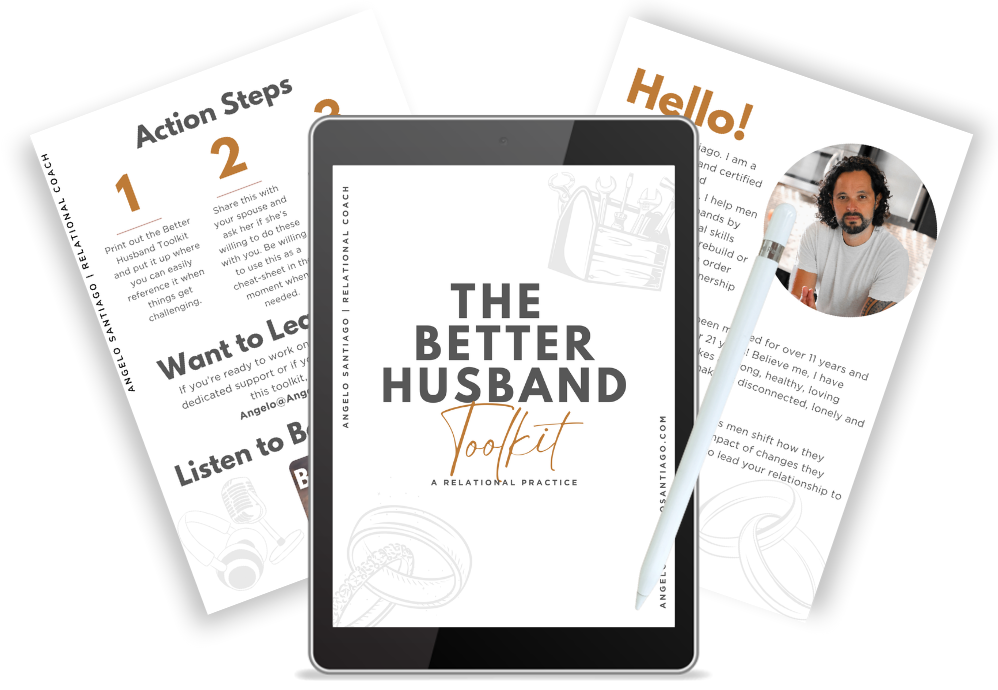
You can also download the Better Husband Toolkit for practical communication tools, connection exercises, and simple frameworks to help you become more emotionally present, supportive, and intentional in your relationship.
Need Help In Your Marriage?
Subscribe to the Better Husband Newsletter to get weekly updates with marriage support, new blog posts, podcast updates and more!
By signing up you consent to receive regular emails from Angelo Santiago with updates and the occasional promotion for services. You can unsubscribe at any time. View our detailed privacy policy in the footer.

Author