
The Hidden Way Self-Criticism Weakens Your Marriage
Jan 15, 2026
For many men, the most damaging voice in their marriage is not their wife’s frustration or criticism. It is the voice already running in their own head.
That voice shows up the moment something goes wrong. You forget something important. You say the wrong thing. You mishandle a conversation. Before anyone else reacts, the verdict is already in: You blew it. You should know better. You always mess this up.
At first glance, that internal harshness can feel like accountability. You might think that being tough on yourself keeps you sharp and prevents future mistakes. In reality, it does the opposite. It traps you in judgment, erodes emotional safety, and quietly spills into the way you show up in your marriage.
Self-contempt does not stay contained. It shapes your tone, your patience, and your ability to stay open when things get hard. Over time, it makes connection feel risky and repair feel impossible.
How Self-Contempt Shows Up at Home
When you live with a harsh inner critic, vulnerability becomes dangerous. Admitting mistakes feels like confirming your worst fears about yourself. Receiving feedback feels like an attack instead of an invitation to grow.
In marriage, this usually plays out in one of two ways. You either turn the contempt inward and collapse, or you flip it outward and defend yourself by going on the offensive.
Both reactions create distance, and frankly, neither builds trust.
If you recognize yourself becoming defensive, withdrawn, or emotionally unavailable when tension shows up, it may not be because you do not care. It may be because the voice in your head has already decided you are failing, and your nervous system is scrambling to survive the moment.
What Is Contempt, Really?

Contempt is more than frustration or disappointment. It is a corrosive form of judgment that devalues someone’s worth. When directed at another person, it communicates superiority. When directed at yourself, it becomes shame.
Shame does not say, I made a mistake. It says, I am the mistake.
The problem is that contempt, in any direction, shuts down connection. When you are trapped in it, you cannot stay curious. You cannot listen openly. You cannot offer care or receive it. Your system is too busy defending your worth.
In marriage, this creates a cycle where conflict escalates quickly or shuts down completely. Either way, the relationship pays the price.
Shame and Grandiosity: Two Sides of the Same Coin
Contempt tends to show up in two predictable patterns.
The first is shame. This is the “one-down” position. You internalize blame, assume you are broken, and withdraw emotionally. You may stop engaging, stop initiating, or stop believing repair is possible.
The second is grandiosity. This is the “one-up” position. You externalize blame, correct your wife, dismiss her feelings, or focus on how she is the problem. This stance can look confident on the surface, but underneath it is still driven by insecurity and fear.
Although these patterns look different, they are fueled by the same belief: Someone here is fundamentally wrong. As long as contempt is running the show, intimacy cannot grow.
Conditional Worth vs. Real Self-Esteem
Many men were taught that self-esteem must be earned. You perform well, achieve success, and receive approval, and only then do you get to feel good about yourself.
This creates conditional worth, which rests on unstable ground. When your value depends on performance, approval, or status, every failure becomes a threat to your identity.
There are three common forms of conditional self-esteem:
- Performance-based: You matter when you succeed or achieve.
- Other-based: You matter when others approve of you.
- Attribute-based: You matter because of what you have or how you appear.
The problem is that all of these can disappear overnight. When they do, contempt rushes in to fill the gap.
Real self-esteem is different. It is not based on outcomes. It is the ability to hold yourself in warm regard even when you fall short. It sounds like this: I messed up, and I still matter.
That steadiness is what allows repair in marriage. Without it, mistakes spiral into shame or power struggles instead of growth.
Stepping Off the Contempt Conveyor Belt
Contempt operates like a conveyor belt. Once you step onto it, you are carried automatically toward shame or superiority. Most men do not notice they are on it until they are already reacting.
The work is learning how to step off.
In Relational Life Therapy, developed by Terry Real, this is described as moving into full respect living, which means no contempt toward your partner and no contempt toward yourself. (This is an ideal place to include an external link to Terry Real’s work or an overview of Relational Life Therapy.)
Stepping off the conveyor belt requires practice, not willpower. It is about noticing when judgment takes over and choosing a different response before it escalates.
The Adaptive Child and the Wise Adult
One reason contempt feels automatic is that it is often driven by a younger, protective part of you. This is sometimes called the adaptive child. It learned how to survive earlier experiences by becoming harsh, rigid, or defensive.
When this part is running the show, reactions are fast and extreme. You either collapse inward or puff yourself up. Neither response reflects your best self.
The wise adult is different. This part of you can tolerate discomfort without losing balance. It can hear feedback without spiraling. It can disagree without making the moment a battleground.
Your wife feels the difference immediately. When the adaptive child takes over, she experiences unpredictability or distance. When the wise adult shows up, she feels steadiness and safety. Can you guess which one she probably prefers?
Practical Ways to Disrupt Contempt
Breaking the habit of contempt requires intentional repetition. Here are four practices that help retrain your response:
- Practice loving-kindness toward yourself. Start by directing warmth toward something you already care about deeply, then slowly extend that same energy toward yourself, especially when you fall short.
- Dispute the shame voice with grounded truth. Do not replace self-attack with fake positivity. Replace it with reality: I made a mistake. I can learn. I am still okay.
- Use a regulating mantra. One phrase that comes from Terry Real’s work is: I am enough, and I matter. Repeating this during moments of self-judgment helps anchor you in respect instead of contempt.
- Commit to full respect living. When you notice yourself going one-down or one-up, pause and bring yourself back to equal footing. Neither superior nor inferior. Human and worthy.
How This Changes Real Moments at Home

When contempt is interrupted, everyday interactions shift.
If your wife points out something you forgot, you no longer need to defend or collapse. You can acknowledge it and respond calmly.
Whether it’s a tough discussion with your wife, or trying to put the kids to bed, learning how to be generous with and kind to yourself gives you the clarity and confidence to address the situation at hand with grace and patience. If your wife’s tone is sharp after a hard day, you can recognize that the moment is not about your worth. If your kids are refusing to go to bed quietly, you can modify your strategy to be more effective.
Over time, this steadiness becomes one of the most stabilizing forces in a marriage. Emotional safety increases because reactions are no longer unpredictable or punitive.
Action Steps for This Week
If you're feeling a little overwhelmed with where to start combatting self-contempt, don't worry. Here are some clear, actionable steps that can get you started:
- Notice one moment of contempt. Write it down, whether it is aimed at yourself or your wife.
- Dispute it with grounded truth. Replace judgment with accuracy and compassion.
- Practice the mantra daily. Repeat “I am enough and I matter” when the inner critic shows up.
- Pause and re-center. When you feel yourself going one-down or one-up, breathe and return to equal footing.
Questions to Ask Yourself This Week
Taking action is a great way to get the ball rolling, but it's important to reflect on questions related to this as well.
Use this week to sit down and think about the following questions. Don’t worry if the answer doesn’t come immediately. But similarly, don’t give up on finding an answer. If it helps, write them down, or talk about them with a trusted confidant.
- What does your inner voice sound like when you fall short?
- Do you default more toward shame or superiority?
- How does that pattern affect your wife?
- What might shift if you consistently chose respect instead of contempt?
A Steadier Way Forward
Contempt is one of the fastest ways to erode connection in a marriage. Whether it is turned inward or outward, it blocks vulnerability and repair.
Respect, practiced consistently, creates the opposite effect. It allows you to acknowledge mistakes without collapsing and to engage conflict without escalating. Over time, this steadiness becomes the foundation for trust, intimacy, and lasting connection.
–
Go Further
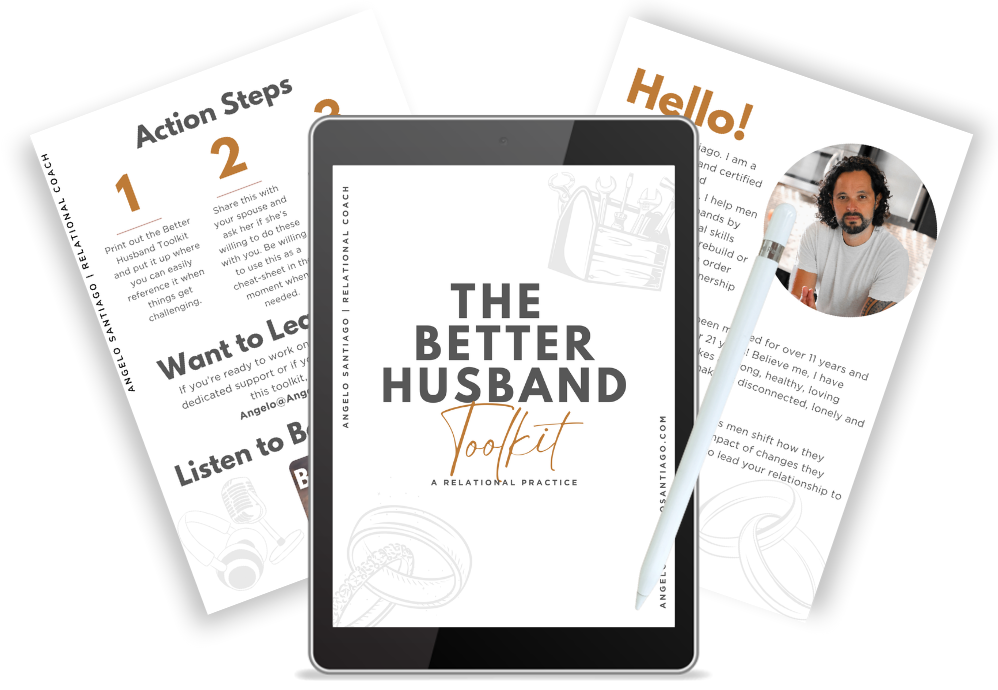
If you want to go deeper into this work, check out the Better Husband Toolkit for practical exercises to put this work into practice.
And as always, don’t forget to listen to the accompanying podcast episode. It will walk through these concepts in a practical, structured way.
Both of these resources are designed to help you move out of self-judgment and into the kind of grounded presence your marriage needs.
Need Help In Your Marriage?
Subscribe to the Better Husband Newsletter to get weekly updates with marriage support, new blog posts, podcast updates and more!
By signing up you consent to receive regular emails from Angelo Santiago with updates and the occasional promotion for services. You can unsubscribe at any time. View our detailed privacy policy in the footer.

Author