
Can AI Help Your Marriage? Here's What It Can (and Can't) Do
Jun 25, 2026
Artificial intelligence is changing how we learn.
Today, you can ask a question and receive a thoughtful answer in seconds. Instead of sorting through dozens of articles, books, or videos, you can get immediate feedback, explanations, frameworks, and ideas. You could be looking for help with nutrition, fitness, productivity, parenting, relationships… AI makes information more accessible than ever.
I'm not opposed to that. In fact, I use AI regularly because I believe it can be a useful tool. It helps you brainstorm ideas, organize projects, research topics, and solve everyday problems more efficiently. Like many people, I’ve found myself opening an AI chat window before opening a search engine.
But there’s an important realization that you need to come to: AI can help you understand your marriage, but it cannot change your marriage.
That's because marriages are not transformed by information alone. They change when people begin behaving differently inside real relationships.
As AI becomes more integrated into daily life, many men will naturally begin using it to better understand themselves and their marriages. In many ways, that's a good thing. The risk isn't using AI. The risk is mistaking awareness for change.
The Difference Between Understanding and Transformation
A while back, I was sitting at my computer using AI to help me work through some ideas. As I moved between notes, projects, and conversations, a simple thought occurred to me: none of this matters unless I actually do something with it.
I can ask for the perfect meal plan, but I still have to cook the food.
I can get a detailed workout program, but I still have to walk into the gym and do the work.
The same principle applies to marriage.
You can learn everything there is to know about communication, emotional intelligence, vulnerability, conflict resolution, and connection. You can read books, listen to podcasts, ask thoughtful questions, and develop a deep understanding of why certain patterns exist in your relationship.
Yet eventually, you find yourself sitting across from your wife during a difficult conversation, and that's where information reaches its limit.
Knowing that you become defensive is different from interrupting defensiveness when it appears. Understanding that you tend to shut down during conflict is different from staying engaged when every instinct tells you to withdraw. Learning about repair is different from offering a sincere apology when you've caused hurt.
This is the gap many men struggle to recognize. They assume that because they're learning, they're changing. While learning is an important first step, understanding and execution are not the same thing. One happens in your mind, while the other happens in your marriage.
Why Learning Feels Like Progress

Part of what makes AI so compelling is that it provides clarity quickly. When you're confused, frustrated, or unsure how to handle something in your relationship, getting a clear answer feels productive.
The challenge is that gaining insight often creates the feeling of progress before any actual change has occurred. You finally understand a recurring argument, you discover language for a pattern you've struggled to describe, or you identify a blind spot you've never noticed before. All of that feels meaningful because it is!
However, your wife hasn't experienced anything different yet.
The way you respond under pressure may still be the same. The conversations may still follow familiar patterns. The habits that create distance may still be operating exactly as they were before.
This is a phenomenon that goes back long before AI existed. Many men can accurately explain their relational struggles. They know when they become defensive, or when they stop listening. They know the difference between understanding their wife and trying to fix her. Yet when conflict arises, they often fall back into the same behaviors they've been practicing for years.
If that sounds like you, then you know it’s not because you’re unwilling to change. It's because insight and implementation require different skills. One requires awareness, and the other requires practice.
AI is going to make awareness easier than ever before. That's valuable, but we shouldn't confuse clarity with transformation.
Where AI Can Actually Help
Despite its limitations, AI can be a genuinely useful tool for husbands who want to grow.
One of its greatest strengths is helping you find language for experiences you’ve struggled to understand. You probably know something feels off in your marriage but can't quite explain what it is. You recognize recurring arguments, emotional distance, or frustration, but you don't have the vocabulary to describe what's happening beneath the surface.
Being able to name a pattern matters. Once you can identify something clearly, it becomes much harder to ignore.
AI can also be helpful for self-reflection. It can help you organize your thoughts before an important conversation, and explore different perspectives. It makes understanding concepts like emotional presence, validation, repair, and vulnerability clearer. In that sense, it can serve as a useful educational tool.
At the same time, every husband should understand one of AI's biggest limitations: it only knows what you tell it.
If you describe a disagreement with your wife in a way that highlights your perspective while minimizing hers, the response you receive will be based on an incomplete picture. AI doesn't know your history, your blind spots, your habits, or the dynamics that exist between you and your spouse. It can provide information, but it cannot fully understand your relationship.
That's why AI can be a helpful guide, but it should never become your primary source of truth about your marriage.
The Work Technology Can't Do
The deeper issues in your marriage aren't caused by a lack of information. They're caused by the moments when emotions, habits, and nervous-system reactions take over.
The challenge is staying calm when you feel criticized and being vulnerable when it feels uncomfortable. You need to learn to overcome your pride and take responsibility after you've hurt someone.
Those moments happen in real time. They happen when your body is tense, your emotions are activated, and your instincts are pushing you toward familiar reactions. No technology can step into that moment for you.
Growth in marriage requires practicing new responses often enough that they eventually become natural. You have to learn how to stay present when you want to leave, listen when you want to defend yourself, and remain open when you'd rather shut down.
Those skills are developed through experience.
Why Real People Still Matter
This is also why personal growth rarely happens in isolation.
Marriage is relational work, which means the skills you're trying to build become stronger through relationships, not just through learning about relationships. At some point, you need people who can challenge you, encourage you, and help you see what you cannot see on your own.
One of the biggest dangers of trying to improve alone is that we become the sole interpreter of our own behavior. Left to ourselves, we can usually find a way to justify our actions, explain away our mistakes, or convince ourselves we'll handle something differently next time.
Other people have a way of disrupting that pattern.
A trusted friend, mentor, coach, or group of men can often spot blind spots that remain invisible to us. They can challenge the story we're telling ourselves, ask better questions, and hold us accountable to the changes we say we want to make.
Just as importantly, they can encourage us when we're making progress that we struggle to see ourselves.
This is one reason community matters so much. Growth accelerates when it moves from private reflection into shared practice. The work stops being an interesting idea and becomes a commitment that other people can help you follow through on.
Awareness Is the Starting Line

The most important takeaway from all of this is that awareness is not the goal.
Awareness is where growth begins, sure. Before you can change a pattern, you have to recognize it. Before you can improve your marriage, you need to understand what's contributing to the challenges you're facing.
But awareness is only the starting line.
If your wife isn't experiencing anything different from you, then more information probably isn't the answer. The next step is applying what you've learned in the moments that matter most. And that's true whether the information came from a book, a podcast, a coach, or an AI chat window.
The men who create lasting change in their marriages aren't necessarily the ones who know the most. It’s easy to intellectualize your relationship and feel like you’ve done the work. The real shift comes when you consistently put what you know into action.
The Opportunity in Front of You
There’s no doubt about AI’s potential to help many men become more self-aware. It can help them identify patterns faster, understand relationship dynamics more clearly, and find language for experiences they've struggled to describe for years.
Those are meaningful benefits. But no technology can become a better husband for you.
Your marriage changes when you stay in the conversation instead of shutting down and when you take responsibility without becoming defensive. In order for your marriage to survive, you have to learn to continue to do the work long after motivation fades.
Those are deeply human skills, and they still require the same things they've always required: humility, courage, consistency, discipline, and practice.
AI can point you toward growth, but only you can do the work.
–
Putting It Into Practice
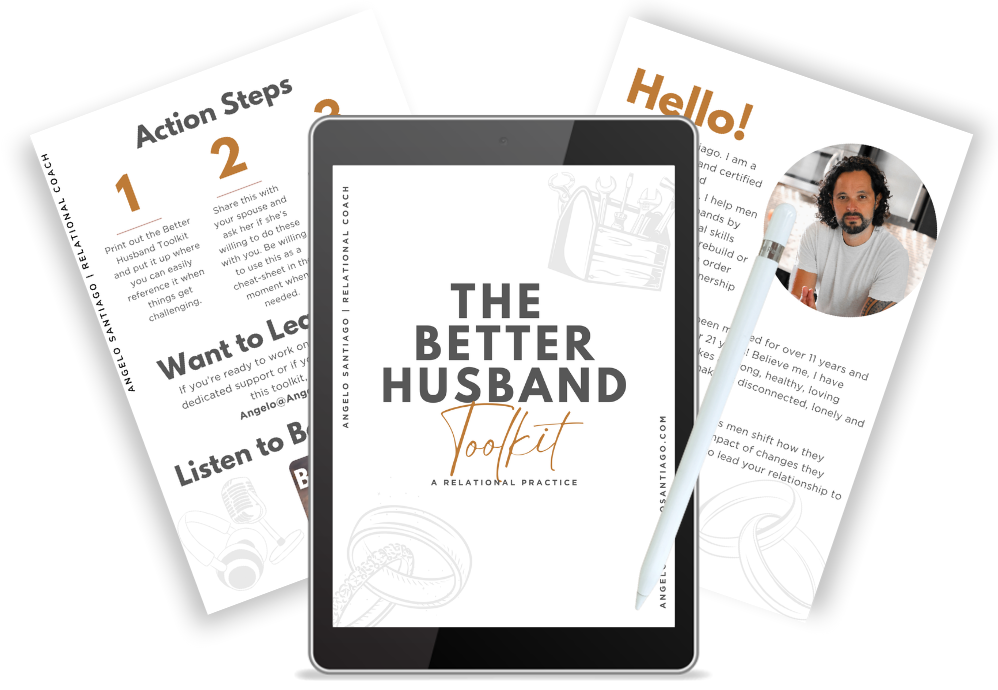
Tired of collecting information and ready to create real change? Listen to the full podcast episode and download the Better Husband Toolkit. Both are designed to help you move from awareness to action in your marriage.
Need Help In Your Marriage?
Subscribe to the Better Husband Newsletter to get weekly updates with marriage support, new blog posts, podcast updates and more!
By signing up you consent to receive regular emails from Angelo Santiago with updates and the occasional promotion for services. You can unsubscribe at any time. View our detailed privacy policy in the footer.
Author