
How to Lead Your Marriage Back from the Breaking Point
Dec 11, 2025
In Jurassic Park, there’s a moment that illustrates the exact dilemma many men face in their marriage. The T-Rex emerges from the trees during the first attack, and the characters respond in three different ways. One man panics and runs. Another freezes, hoping stillness will save him. And Dr. Ian Malcolm does something counterintuitive: he moves. He grabs a flare, steps into the open, and draws danger away from the people who need protecting.
Your wife isn’t a tyrannosaurus rex, of course, but the metaphor is painfully accurate: in a moment of relational crisis, you can run, you can freeze, or you can move. And if you want to shift the direction of your marriage—especially when things feel distant, strained, or close to breaking—you must be the piece that moves first.
Why Waiting Feels Safe—but Silently Damages Your Marriage
Men often imagine that “waiting” is the responsible or respectful thing to do. You tell yourself you’re giving her space, and that by doing so, you avoid making things worse. But one of the biggest mistakes you can make is assume that if the issue really mattered, she’d bring it up again.
Because waiting is rarely neutral. In a marriage, waiting almost always communicates something louder than you think:
“I’ll only show up when I’m forced to.”
Your wife feels that. She feels it when she’s the one who always brings up what’s bothering her, or when she initiates every vulnerable conversation. She feels it when she notices the distance and you pretend you don’t, or when she realizes she’s carrying the emotional weight of two people.
If you have read enough of the Better Husband blog, you’ve definitely heard this before: most marriages don’t fall apart because of a single dramatic blowup; they fall apart because one partner—often the man—gets caught in years of quiet avoidance.
That’s years of freezing when things get tense and telling himself, “It’s probably fine,” when it clearly isn’t.
Waiting feels safe in the moment, but long-term, it slowly erodes intimacy until there’s almost nothing left.
A Client Who Finally Moved—When It Mattered Most
I once worked with a man who had spent years being “careful” in his marriage. He avoided conflict, stayed quiet, and waited for a better moment to talk. He thought he was being patient and steady. His wife experienced him as distant and emotionally absent.
Eventually, she told him something she had been carrying for a long time: She didn’t feel close to him anymore. She didn’t know if the marriage could keep going.
When he told me about that conversation on our first coaching call, I asked him one simple question:
“Based on how you’ve handled conflict in the past, what do you think she expects you to do now?”
He paused. Then it hit him.
“She expects me to do nothing.”
And he was right! His pattern had trained her to assume he would freeze. She expected silence and passivity. In other words, a man who waits.
After that conversation, he decided to do something he’d never done before: he decided to move.
He didn’t panic or overcorrect. He didn’t try to solve everything in one conversation. He simply initiated the next step by asking her to talk again. And in that next conversation, he asked questions, listened without defending, stayed grounded, and remained present. By keeping these things in mind, he was able to reinitiate connection instead of waiting for her to do it.
And slowly, something shifted.
Their marriage didn’t miraculously transform overnight, but the dynamic did. She saw that he wasn’t relying on her to carry all the emotional weight anymore, and for the first time in years, he was the one who moved. That single shift created a path forward they hadn’t been able to find before.
Confusing Passivity with Patience

Most men don’t freeze because they’re lazy. Instead, they freeze because they’re afraid.
Afraid of being misunderstood, or of doing it wrong. There’s also a very real fear of her reaction—or her silence. And that once they open the door, they’ll have no idea what to do next.
Sometimes it can even go so far as being afraid that, deep down, it’s already too late.
So instead, they wrap that fear in nicer language:
“I don’t want to make it worse.”
“She already has so much on her plate.”
“It didn’t seem like the right time.”
But avoidance dressed up as patience is still avoidance. It still communicates indifference and deepens the distance between both.
Here’s the hard truth: your silence teaches her something. It teaches her that you’ll stay comfortable even when the marriage isn’t, and that she’s on her own emotionally. It teaches her that you react, but you don’t lead.
And eventually, she stops wanting to remind you of what she needs.
What It Actually Looks Like to Move First
Moving first doesn’t mean you need the perfect words, that you need to fix everything in one conversation, or even that you suddenly have to become a relationship expert.
Moving first simply means you stop waiting for her to close the gap between you. What does that look like?
It’s naming the tension instead of pretending it isn’t there:
“Hey, something feels off between us. Can we check in?”
It looks like curiosity instead of defensiveness:
“What’s been feeling hard for you lately?”
“Is there something I’ve been doing—or not doing—that’s made it harder to feel close to me?”
It looks like staying present even when she says something painful. You breathe. You listen. You acknowledge. You say, “Thank you for telling me. I want to understand.”
Instead of being dramatic, movement is actually steady and vulnerable. It’s you choosing connection over comfort, and leadership instead of waiting for her to do the emotional labor for both of you.
This is what I call relational leadership, and every strong marriage needs one partner willing to take that first courageous step.
The Most Important Step to Breaking the Standoff
In Relational Life Therapy, one of the core winning strategies is this: respond with generosity.
Generosity is what breaks the stalemate couples get stuck in—the tension-filled stand-off where each person is waiting for the other to soften first.
Responding with generosity means you shift your mindset from
“What am I getting?”
to
“What does this relationship need from me right now?”
This doesn’t make you a doormat, or that your needs don’t matter. It simply means you stop negotiating connection like it’s a transaction.
Maybe the relationship needs a softer tone, appreciation, ownership or curiosity. Maybe it needs you to stay present when you normally shut down.
And yes—sometimes generosity won’t be immediately reciprocated. Sometimes your effort won’t produce the outcome you hoped for.
But that’s not failure. That’s you changing the pattern.
Generosity says:
“I’m not here because it’s my turn. I’m here because I choose us.”
And that shift alone is powerful enough to change the trajectory of a marriage.
How to Begin Leading
- Identify where you’ve been waiting.
Name the area where you’ve hit pause. The conversation you’ve avoided. The distance you’ve gotten used to.
- Play the tape forward.
Where does this lead if nothing changes? What does waiting cost your marriage—and you?
- Make one move toward her.
Not a fix. Not a performance. A genuine invitation.
Something like:
“I’ve been thinking about us. I don’t want us to stay in this distance. Can we talk?”
- Lead with generosity.
Show up with presence, curiosity, and care. Not blame, and definitely not scorekeeping.
Small moves done consistently change everything.
Freeze, Flee, or Lead—The Choice Is Yours

In every marriage, there will be moments where you face the emotional equivalent of a T-Rex stepping out of the trees. Moments where you’re scared, uncertain, or tempted to shut down.
You can run from it like the lawyer in Jurassic Park. You can freeze like Dr. Grant and hope the danger passes on its own, or you can do what Dr. Malcolm did: step out, flare in hand, and make the conscious decision to lead.
Movement won’t always be clean or comfortable. Your hands might shake, your voice might crack. But courage isn’t the absence of fear—it’s the decision to act anyway.
And just like in the movie, what you think is the enemy might not be the real threat. The real danger is waiting too long to show up.
If you want your marriage to change, be the piece that moves.
–
Learning to Lead
And if you’re ready to take the next step to leading in your marriage, communicate with presence, and rebuild real connection, that’s exactly what we do inside Better Husband Academy—a self-paced course and group coaching program designed for men who are serious about transforming their marriage.
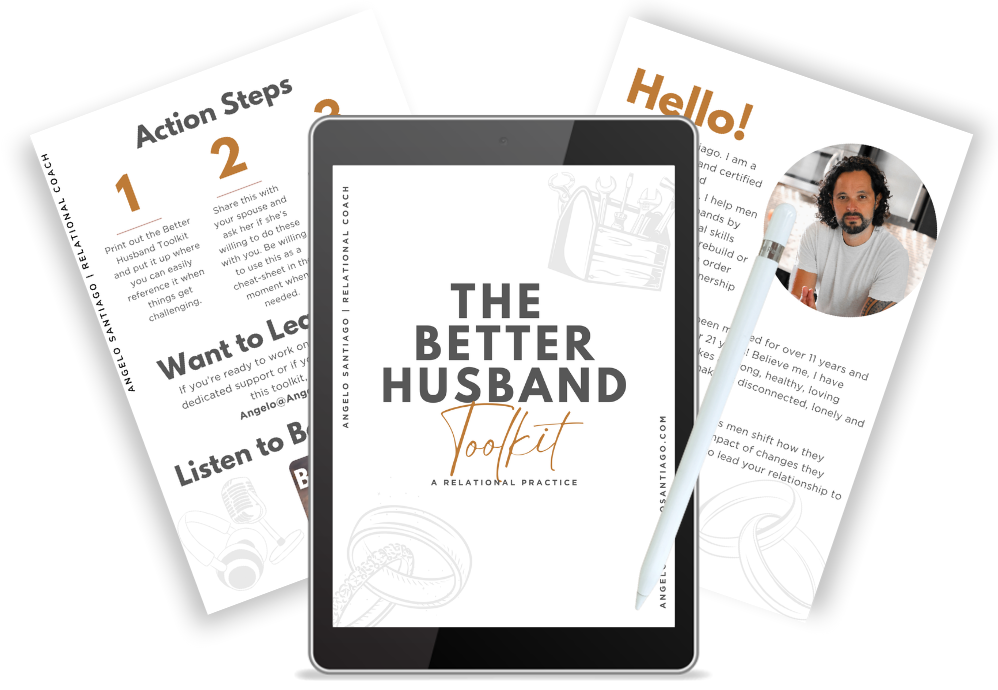
If you’re ready to get started now, then download the Better Husband Toolkit.
And while you’re at it, give the podcast episode a listen.
You don’t have to do this alone. But you do have to take the first step.
Need Help In Your Marriage?
Subscribe to the Better Husband Newsletter to get weekly updates with marriage support, new blog posts, podcast updates and more!
By signing up you consent to receive regular emails from Angelo Santiago with updates and the occasional promotion for services. You can unsubscribe at any time. View our detailed privacy policy in the footer.

Author